The blue hole: why Abisko's sky clears
Abisko has a name among aurora watchers for clear nights, and the reason sits in the mountains to its west. Locals call the patch of open sky the blue hole. It raises your odds of a clear night, but it does not promise one.
A rain shadow behind the mountains
Weather reaching northern Scandinavia often rolls in wet from the Atlantic, heavy with cloud. The mountains along the border with Norway sit in its way, west of Abisko.
The air cools as it rises over them and drops much of its moisture on the western slopes. By the time it sinks down the eastern side towards Abisko it is drier, so the cloud often thins or breaks.
That effect is called a rain shadow. It is the main reason Abisko tends to see less cloud than places closer to the coast.
The Norwegian side, around Narvik at the other end of the Ofoten Line, tends to catch more of that wet weather. A cloudy coast and a clear Abisko on the same evening is a common pattern, though not a rule.
What the blue hole means
The blue hole is the local name for the clear patch that often opens over Abisko while the sky around it stays grey. In daylight you can sometimes see it as a gap of blue framed by cloud over the peaks.
For aurora watchers, it is an advantage, not a promise. Weather systems do push through and some nights stay overcast. The aurora is never guaranteed even under a clear sky.
Think of it as better odds per night rather than a sure thing. Two or three nights in Abisko give the blue hole more chances to work, and our season guide helps you choose the weeks.
Lake Torneträsk and the open view
Lake Torneträsk, one of Sweden's largest lakes, stretches along the north side of the village. Frozen for much of the winter, it gives a wide flat view to the north with no trees in the way.
That open horizon matters for photographs as much as for watching. A frozen lake adds a white foreground, and our photography guide explains how to use it in a frame.
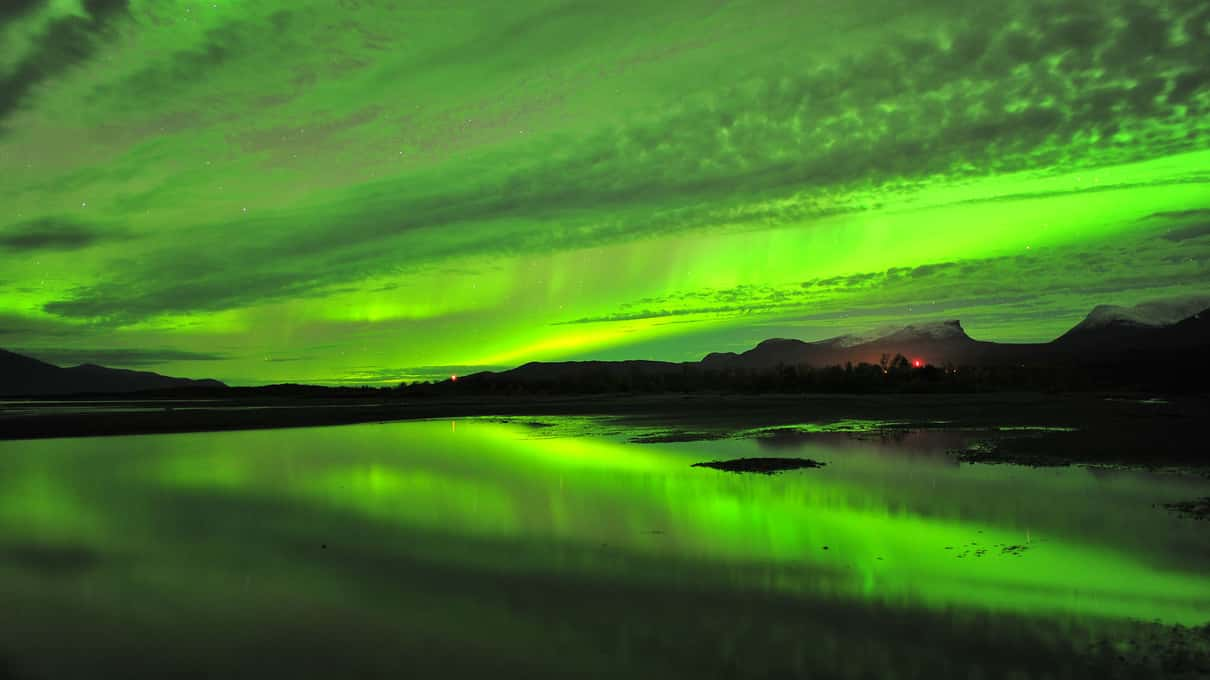
Before the lake freezes, still water can mirror the aurora. Abisko itself is a small village with few lights to wash out a faint glow, and it sits some 200 km (125 miles) above the Arctic Circle.
The iron ore railway and the E10 road run along the south shore, so most viewpoints are easy to reach. A short walk from the village takes you clear of the last streetlights.
Lapporten frames the view west
Lapporten is a U-shaped valley carved by glaciers. It lies west of Abisko and is visible across Torneträsk. Its two rounded slopes form a gateway that many people recognize from photographs of the area.
It also points towards the mountains that create the rain shadow. On a clear night, the silhouette makes a strong backdrop for aurora pictures taken from the lake shore.
Abisko National Park
The village sits at the edge of Abisko National Park, a protected stretch of birch forest and mountain valley. Its darkness is a large part of why the aurora looks so bright here.
Several tours use the park's edge. The snowmobile routes run through the Abisko valley along the park boundary, and the photo tour carries the park's name in its GetYourGuide title.
By day, the trails into the park make good use of the same clear weather. A walk to the canyon near the village fills an afternoon before an evening tour without tiring you out.
Under the auroral oval
The aurora appears in a ring around the magnetic pole known as the auroral oval. Abisko lies beneath it, so the lights are often overhead rather than a low glow on the northern horizon.
That position means even a fairly quiet night can show aurora above the village. Our guide to the Kp forecast explains how to read the activity numbers, and why cloud usually matters more.
Planning a stay around the clear patch
The blue hole works over a run of nights, not on a single one. Book your tour for the first evening of your stay, so that a cloudy night still leaves room for a second try.
Every tour on our list cancels free until 24 hours before the start. That lets you watch the cloud forecast the day before and move a booking if the outlook turns grey.
Guides watch the same forecasts and know where gaps usually open. On the night, trust their call on where to stand, since they have seen far more skies over Torneträsk than any app has.
Why a chase still matters
Clear skies over Abisko are common but not constant. On a mixed night, cloud can sit over the village while a valley a few kilometers away stays open.
Lights Over Lapland's aurora chase from ~$100 will go as far as 100 km (60 miles) out and back to find the clearest spot. Many of its stops are on frozen lakes and rivers, which can mirror the lights.
A bus that follows the gaps in the cloud
Hotel pickup in Björkliden or Abisko, then a drive to whichever spot looks clearest that night. Warm clothing is lent and a hot drink comes on the way.
It holds 4.9 from 200+ reviews on Viator and 4.5 from 350+ on GetYourGuide. Up to 28 people ride along, so expect a full bus in exchange for the low fare.
The other tours move less or not at all, which our comparison of the ways to chase lays out. If the blue hole fails you entirely, our cloudy-night plan has ideas for the next day.