Abisko aurora season from September to March
The northern lights over Abisko need a dark sky, and the village only gets one for about seven months of the year. Each stretch of that window feels different on the ground, from mild autumn evenings by open water to deep cold on snow. Choose by what you want around the aurora, since the aurora itself keeps no calendar.
Why the season stops in spring
The aurora happens all year, high above the Earth, but you can only see it against a dark sky. Abisko lies about 200 km (125 miles) north of the Arctic Circle, so from late spring the sun barely sets and the nights stay bright.
That leaves a viewing window of roughly early September to late March, when the dark hours are long enough to matter. The edges are soft, and a clear night in the last days of August or early April can still bring a glimpse.
In June and July the midnight sun rules the aurora out completely. The trails of Abisko National Park are lovely then, but the sky never turns dark enough for anything green to show.
Abisko sits under the auroral oval, the ring around the pole where the aurora is most common, so in the dark months it often shows overhead rather than low in the north. Our guide to reading a Kp forecast explains why that helps on a quiet night.
Autumn by open water
September and October are the gentlest way into the season. The nights are milder than in deep winter, and the birch woods turn yellow and orange before the snow settles for good.
The lakes and rivers are usually not frozen yet, so a still evening can put the aurora in the water as well as the sky. Lake Torneträsk is one of Sweden's largest lakes, and on a calm night its surface can become a long dark mirror.
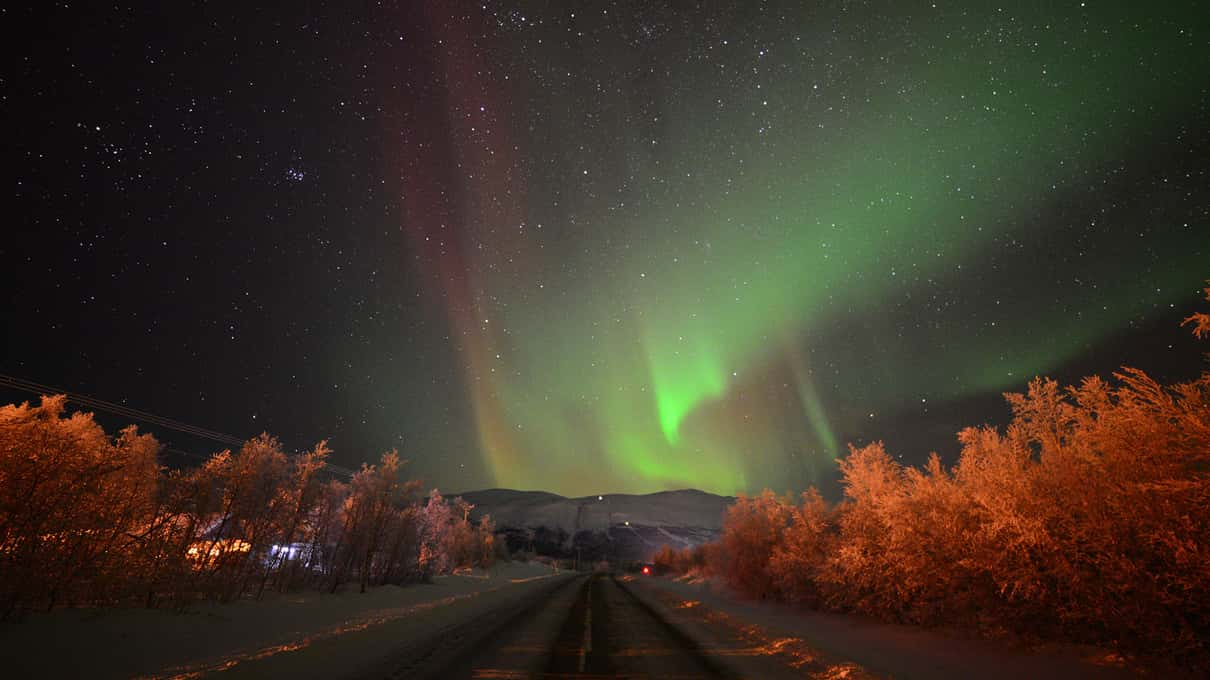
Fewer visitors come in autumn than in late winter, which makes rooms easier to find. The trade-off is shorter darkness in early September, when the sky turns properly black only late in the evening; by October the nights have grown much longer.
The snowmobile tour needs snow on the ground, so it is not an autumn choice. Experience Abisko's snowmobile chase from ~$100 belongs to the middle and late winter instead.
The polar night around the solstice
For a few weeks around the winter solstice, roughly early December to early January, the sun stays below the horizon in Abisko. The polar night is not total blackness. A blue and pink twilight glows for a few hours around midday.
For aurora hunting this brings the longest darkness of the year, and the sky can be dark from mid-afternoon. It is also one of the coldest stretches, and the snow cover is usually in place, so snowmobiles can run from roughly December.
Christmas and New Year bring the most visitors to the few places to stay in a small village. Book a room early for those weeks, and read our comparison of sleeping in Abisko or Kiruna if the village is full.
February and March on deep snow
Late winter draws many travelers. The days lengthen fast, so you get proper daylight for hiking or a walk on the ice, and the nights are still long enough for a full evening tour.
The air is often at its coldest now, with nights that can sink to −15 to −25 °C (5 to −13 °F) or lower. Deep snow suits the snowmobile and the husky hike on snowshoes, and our guide to dressing for the cold covers the layers.
The weeks around the March and September equinoxes are often said to be good for auroras. There is a known tendency toward more geomagnetic activity at those times of year, but any single week can ignore it.
Our pick works in any dark month
The Ultimate Aurora Photo Adventure from ~$160 by Lights Over Lapland starts at 7:10 pm and lasts 4 hours, with a maximum of 8 guests. On Viator it scores 4.9 from 500+ reviews; on GetYourGuide, 4.6 from 90+.
The guides choose the plan on the night from the weather and the forecast. Some evenings that means a walk to a nearby teepee or a chase in a 4x4 van, while on others a snowmobile pulls a sleigh out to a wilderness camp.
A camera in your hands, whatever the month
The listing lends a DSLR with the lens preset for the aurora and a tripod, plus warm overalls. Hot lingonberry juice comes with snacks. Bring your own SD card. From ~$160, with free cancellation up to 24 hours ahead; not for children under 10.
The downside is the price, the highest per head of our five, and you do not get to pick the method yourself. Our photography guide covers what the camera teaching on the night does and does not include.
Which tour suits which stretch
- Autumn, with open water: the Abisko Aurora Chase from ~$100, a bus that covers up to 100 km (60 miles) and stops at many lakes and rivers
- Midwinter and late winter: the snowmobile tour from ~$100 once the snow is down; snowsuits and boots are lent
- Any dark month, on foot: the husky hike from ~$140, about 4 km to a lávvu with a fire
- Any dark month, with photos of you: Explore Arctic's car chase with a photographer from ~$146
Operating dates vary by company, so open the listing's calendar before you settle on a week. All five listings let you cancel at no charge up to 24 hours before the start, and our price guide compares what each one costs per hour.
Several nights beat one chosen date
No month guarantees the aurora, and no week does either. Clouds decide more evenings than the sun does, and even under Abisko's famous blue hole a front can sit over the valley for days.
A stay of three or four nights gives you several tries at a clear sky. Book your tour for the first evening so a grey night leaves room for another go, and read our plan for a night with no aurora.
The moon plays a part too. A full moon brightens the snow and can wash out a faint aurora, though a strong display still shows, so the days around the new moon suit photographers who want the darkest sky.