Reading a Kp forecast for Abisko
Aurora forecasts look technical, but you only need a few numbers to make sense of them in Abisko. The Kp index hints at how active the sky may be, while the cloud forecast tells you whether you could see anything at all. Neither can promise an aurora.
The Kp index in plain words
The Kp index is a scale from 0 to 9 that measures how disturbed the Earth's magnetic field is, based on readings from stations around the world. Higher numbers mean a more active field and an aurora that reaches farther from the poles.
Forecasts give Kp in three-hour blocks, and a forecast for a day or more ahead is a rough guide. It tells you whether activity is expected to be quiet or lively, not what the sky over Abisko will do at 10 pm.
Why a low Kp can still work in Abisko
Most aurora sits in a ring around the magnetic pole called the auroral oval. Abisko lies under that ring, so the aurora is often overhead here rather than a glow low on the northern horizon.
That is why a Kp around 2 or 3 can often show aurora above Abisko, while towns farther south need much higher numbers. A very high Kp can even push the brightest activity south of the village, though it usually still fills much of the sky.
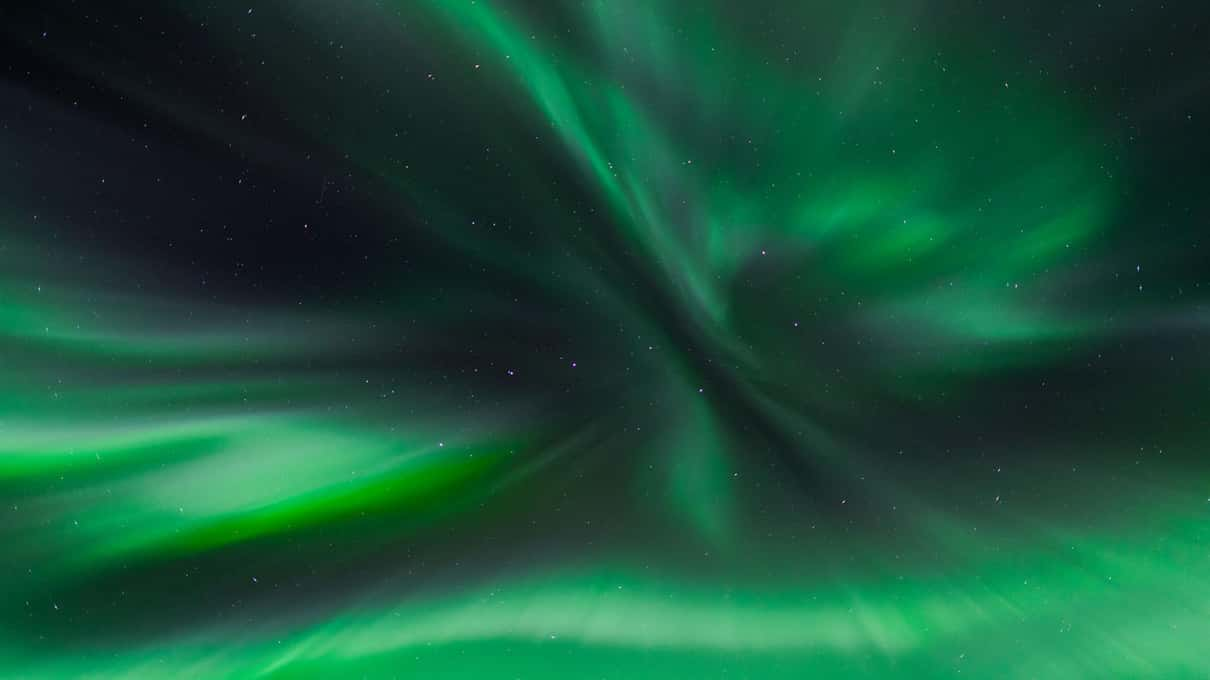
So a low number on the forecast is no reason to stay indoors. Treat Kp as a hint about strength, and look at the clouds before you decide anything.
Clouds decide more than Kp
The aurora shines about 100 km (60 miles) or more above the ground, far above any weather. A clear sky with modest activity almost always beats a strong storm behind solid cloud.
Abisko's blue hole, the clear patch that forms because the mountains to the west catch much of the weather, tilts the odds toward open sky. It does not promise one, and a front can still cover the whole valley for several nights.
For cloud, use an ordinary weather forecast that shows cloud cover by the hour, ideally one that separates low cloud from high cloud. Thin high cloud lets a bright aurora through, while a low grey layer hides everything.
Solar wind and the Bz reading
Space weather sites also show live data from satellites that sit between the Earth and the sun. They measure the solar wind, the stream of particles the sun sends out, usually less than an hour before it reaches us.
Two readings matter most for a night out. A faster solar wind usually carries more energy, and the Bz value shows which way the magnetic field inside that wind is pointing.
When Bz turns south, shown as a negative number, the Earth's field couples with it more easily and the aurora often brightens soon after. A long spell of southward Bz is one of the clearest signs that a quiet sky may wake up.
These numbers jump about from minute to minute. Watch the trend over half an hour rather than a single reading, and do not read too much into one spike.
None of this needs a science degree. If the cloud map looks open and the Bz has pointed south for a while, it is time to step outside. Look north and straight up.
How the guides use all this
On the night, the guides on a chase tour do this reading for you. They compare cloud maps with the activity data and pick a spot, which is the main thing you pay for on a chase.
Lights Over Lapland's Abisko Aurora Chase from ~$100 heads out on a loop of up to 100 km to whichever of its spots has the best sky; several sit by lakes and rivers. Pickups are at 7:45 pm in Björkliden and 8–8:15 pm in Abisko.
Let the guide read the sky
A bus chase with hotel pickups in Abisko and Björkliden. Warm clothing and camera equipment are provided, with a warm drink along the way. It holds 4.5 from 350+ reviews on GetYourGuide and 4.9 from 200+ on Viator. From ~$100, with free cancellation up to 24 hours before.
The weak point is the size. Up to 28 people share the bus, and much of the evening can pass on the road if the clouds are stubborn. Our price guide sets this against the small-group tours.
A routine for your stay
- In the morning, look at the cloud forecast for the evening and the next two nights
- In the afternoon check the Kp forecast and the moon phase, without reading too much into either
- Before the tour, glance at live solar wind and Bz data if you are curious
- On the tour put the phone away and let the guide make the call
If the forecast looks hopeless the day before, free cancellation up to 24 hours ahead lets you move your booking. Our plan for a night without aurora covers what to do next, and the season guide explains the months and the moon.
For your own pictures, an active forecast is also a cue to set up the camera early. Our photography guide covers settings for a sky that can brighten within minutes.
What no forecast can tell you
Aurora forecasting is still rough. A promising Kp can bring a faint arc and little else, and a quiet forecast can turn into a bright display with almost no warning.
That is why no tour promises the aurora, and why we quote no success rates for Abisko. A few nights in the village, with a tour booked early in the stay, give you more chances than any forecast can.